Archaeological excavations in parts of Kathmandu have found evidence of ancient civilizations. The oldest of these findings is a statue, found in Maligaon, that was dated at 185 AD. The excavation of Dhando Chaitya uncovered a brick with an inscription in Brahmi script. Archaeologists believe that it is two thousand years old. Stone inscriptions are ubiquitous elements at the heritage sites and are key sources for the history of Nepal. The earliest Western reference to Kathmandu appears in an account of Portuguese Jesuit Father Joao Cabral who passed through the Kathmandu Valley in the spring of 1628 and was received graciously by the king of that time, probably King Lakshminarasimha Malla of Kathmandu on their way from Tibet to India. Father Cabral reported that they reached "Cadmendu", the capital of Nepal kingdom.
The ancient history of Kathmandu is described in its traditional myths and legends. According to the Swayambhu Purana, present-day Kathmandu was once a huge and deep lake named "Nagdaha", as it was full of snakes. The lake was cut drained by Bodhisattva Manjushri with his sword, and the water was evacuated out from there. He then established a city called Manjupattan, and made Dharmakar the ruler of the valley land. After some time, a demon named Banasura closed the outlet, and the valley again turned into a lake. Krishna came to Nepal, killed Banasura, and again drained out the water by cutting the edge of Chobhar hill with this Sudarshana Chakra. He brought some cowherds along with him, and made Bhuktaman the king of Nepal.[19][20][21]
Kotirudra Samhita of Shiva Purana, Chapter 11, Shloka 18 refers to the place as Nayapala city, which was famous for its Pashupati Shivalinga. The name Nepal probably originates from this city Nayapala.
Very few historical records exists of the period before medieval Licchavi rulers. According to Gopalraj Vansawali, a genealogy of Nepali monarchy, the rulers of Kathmandu Valley before the Licchavis were Gopalas, Mahispalas, Aabhirs, Kirat, and Somavanshi. The Kirata dynasty was established by Yalamber. During the Kirata era, a settlement called Yambu existed in the northern half of old Kathmandu. In some of the Sino-Tibetan languages, Kathmandu is still called Yambu. Another smaller settlement called Yengal was present in the southern half of old Kathmandu, near Manjupattan. During the reign of the seventh Kirata ruler, Jitedasti, Buddhist monks entered Kathmandu valley and established a forest monastery at Sankhu.
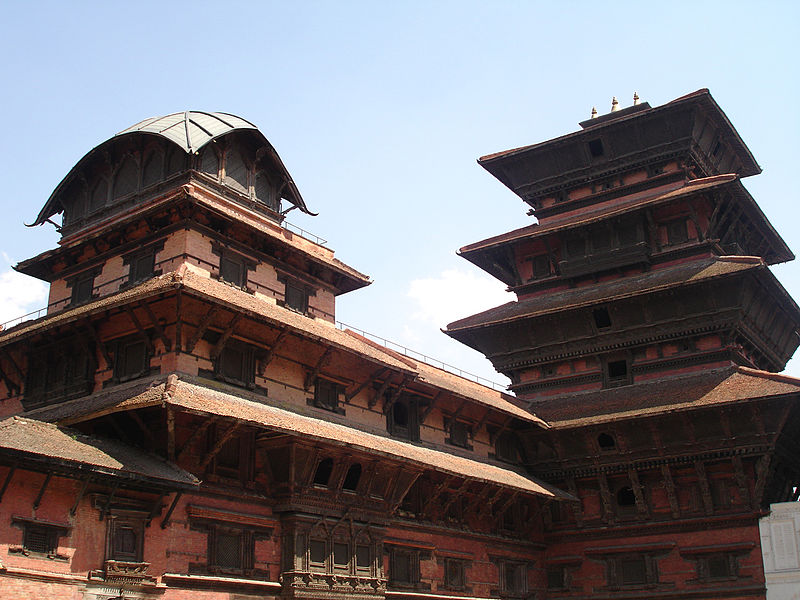
Nepali: हनुमानढोका दरबार; (Basantapur Durbar Kshetra) is a historically and culturally significant site in Kathmandu, Nepal. It is one of the three Durbar (royal palace) Squares in the Kathmandu Valley in Nepal that are UNESCO World Heritage Sites.
Although the construction of the square began in the 3rd century, the major structures within it were added in later periods. The outer complex consists of a number of 16th-century temples built during the reign of the Malla kings. These buildings are adorned with meticulously carved facades characteristic of Newar architecture. The central square is surrounded by palace complexes built during the Malla and Shah periods.The most well known among them is the Nautalle Durbar, a nine-story palace built by Prithvi Narayan Shah to commemorate the Unification of Nepal.
A three-story temple called Kumari Chouk or Kumari Bahal is located at the southern edge of the Durbar square. This Malla-era temple is used by the resident of the Kumari, a young girl worshiped as a living embodiment of the Hindu Goddess Durga.